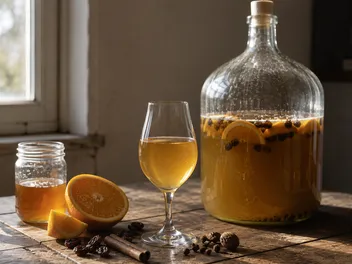
A traditional 1-gallon "kitchen sink" style orange spiced mead adapted from Joe Mattioli, fermented on Fleischmann's bread yeast with no racking until it fully clears. Fermentation and bottling durations not explicitly stated in source beyond "about two months to clear", estimated. https://homebrewtalk.com/threads/joes-ancient-orange-mead.49106/
Shared Recipe
by Fermo Kitchen
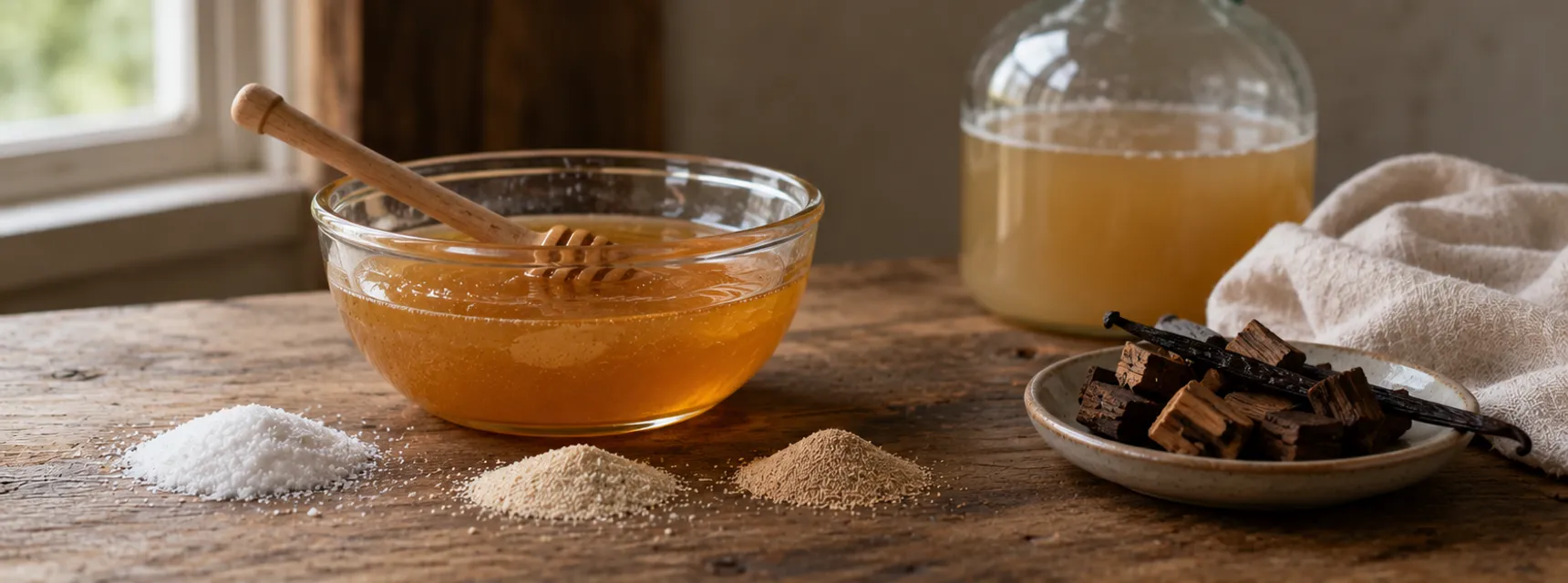
Fast-fermenting dry traditional mead using Wyeast 1388 and a staggered DAP/Fermaid K nutrient protocol, drinkable in about a month. Original gravity about 1.099 sg (~23 brix), finishing dry near 1.000 sg (~0 brix). Primary/secondary/bottling day counts are not specified in source, estimated. Source: https://denardbrewing.com/blog/post/brays-one-month-mead/
Day 0 (start)
Prepare Water: Fill the jug with spring water, leaving enough room below the top for the honey and yeast pack, then mark the fill line.
2.5 lb of orange blossom honey
Add Honey: Add orange blossom honey back up to the marked line for a starting gravity of about 1.099 sg (~23 brix).
1.3 g of DAP
Add Nutrients: First staggered addition of DAP, converted from 1/4 tsp to grams, estimated conversion.
2.5 g of Fermaid K
Add Nutrients: First staggered addition of Fermaid K, converted from 1/2 tsp to grams, estimated conversion.
2 g of potassium carbonate
Add Buffering Salt: One-time addition of potassium carbonate for pH buffering and potassium supply, converted from 1/4 tsp to grams, estimated.
Aerate Must: Seal the jug with the top on and shake vigorously until the honey is fully dissolved; this also aerates the must for the yeast.
Check Original Gravity: Confirm the starting gravity before pitching yeast.
Set Fermentation Temperature: Bring the must and the activated yeast to the same temperature, targeting about 68 F (~20 C) for the first few days.
125 g of Wyeast 1388
Pitch Yeast: Pitch Wyeast 1388 Belgian Strong Ale after activating the smack pack for 1 to 2 hours; do not exceed 2 hours; pack weight estimated in grams for this field.
Airlock Note: Leave the airlock dry with no water for the first 7 days or until gravity falls below 1.033 sg (~8 brix), whichever comes first.
Day 3
1.3 g of DAP
Add Nutrients: Second staggered addition of DAP at roughly the one-third sugar break, day estimated, converted from 1/4 tsp to grams.
2.5 g of Fermaid K
Add Nutrients: Second staggered addition of Fermaid K at roughly the one-third sugar break, converted from 1/2 tsp to grams.
Check Gravity: Confirm gravity is near 1.066 sg (~16 brix) before this nutrient addition.
Day 7
1.3 g of DAP
Add Nutrients: Third and final staggered addition of DAP at roughly the two-thirds sugar break, converted from 1/4 tsp to grams.
2.5 g of Fermaid K
Add Nutrients: Third and final staggered addition of Fermaid K at roughly the two-thirds sugar break, converted from 1/2 tsp to grams.
Check Gravity: Confirm gravity is near 1.033 sg (~8 brix), the trigger point for adding liquid to the airlock.
Add Airlock Liquid: Add water or vodka to the airlock now that gravity has fallen below 1.033 sg (~8 brix) or 7 days have passed.
Day 14
Check Gravity: Confirm the mead has fermented dry to about 1.000 sg (~0 brix), marking the end of primary fermentation; this day count is estimated since the source only gives a 7 to 14 day range.
Rack to Secondary: Siphon the mead off the yeast cake into a clean vessel for clearing, leaving the sediment behind.
3 pcs of american medium toast oak cubes
Optional Oak Addition: Optionally add oak cubes for 2 to 4 weeks of post-fermentation flavor; this step is optional in the source recipe.
2 pcs of french medium toast oak cubes
Optional Oak Addition: Optionally add oak cubes for 2 to 4 weeks of post-fermentation flavor; this step is optional in the source recipe.
1 pcs of vanilla bean
Optional Vanilla Addition: Optionally add a whole vanilla bean for 2 to 4 weeks of post-fermentation flavor; this step is optional in the source recipe.
Day 28
Check Final Gravity: Confirm gravity has been stable for several weeks before bottling to avoid bottle bombs; added for safety, not detailed in original source.
Bottle Mead: Siphon the clarified mead into bottles and cap; this marks the end of secondary and the start of bottle conditioning.
Day 35
Ready to Enjoy: This mead is traditionally ready to drink within about a month of starting, so this bottle conditioning window is a short estimated buffer since the source does not specify a strict post bottling wait.
A simple traditional show mead made with raw, unheated orange blossom honey, staggered nutrient additions and Lalvin 71B-1122, finished with a short rest on oak cubes for a light vanilla note. Nutrient doses converted from 1 tsp per addition to grams; oak amount, sugar break timing and all durations not specified in source, estimated from the author's reported 7 to 8 week turnaround. Final gravity check added for safety, not in original source. Source: https://www.reddit.com/r/Homebrewing/comments/kp3mb/comment/c2vv9p3/

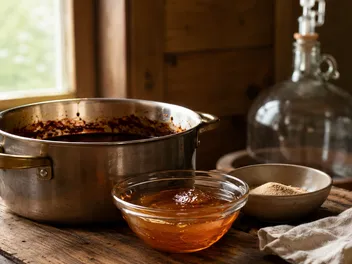
Traditional high gravity bochet (burnt) mead made by caramelizing the honey before fermentation, giving a deep copper color and a toffee-like, sherry-style character. Source: https://homebrewersassociation.org/homebrew-recipe/castle-bochet-mead/ (primary, secondary and bottling durations are not given precisely in the source, estimated here from typical high gravity mead practice)
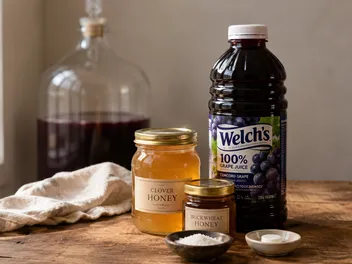
Quick, fast-clearing grape mead (pyment) made with Welch's grape juice and honey, backsweetened and stabilized after primary. Closest available type is Grape Wine (pyment itself is not one of the 8 listed types). Yeast dose not specified in source, standard 5g packet assumed. Buckwheat honey's exact role is disputed in the source discussion (nutrient boost vs flavor), kept here as a small flavor addition. Backsweetened to a sweet finish by default; for a lighter, semi-sweet result use 4oz honey instead of 6oz at the backsweetening step. Source reports the mead was ready to drink in about 5 weeks. Source: https://www.homebrewtalk.com (Joe's Grape Mead / Pyment / Melomel thread)
A traditional 1-gallon "kitchen sink" style orange spiced mead adapted from Joe Mattioli, fermented on Fleischmann's bread yeast with no racking until it fully clears. Fermentation and bottling durations not explicitly stated in source beyond "about two months to clear", estimated. https://homebrewtalk.com/threads/joes-ancient-orange-mead.49106/
